how to order     industrial     railway     maritime     forest of dean     contact     home    

 
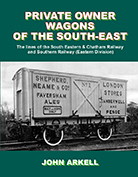
Private Owner Wagons: First Collection

cover


Private Owner Wagons: First Collection
Price: £14.99
Currently out of print


'Their owners ranged from the biggest corporation-owned utility in the country to the landlord of a village pub'

Within this volume over 70 owners of the hard worked privately owned wagon are featured ranging, as in the quote above, from the largest utility to the smallest of coal merchants.

This well-illustrated book not only details the wagons themselves but also the history of their owners. The text also covers the rationale behind private owner wagons, the eccentricities of owners, and gives a comprehensive list of sources and models available of the wagons featured.

The information on each owner has been obtained in record offices and libraries the length and breadth of the country and thus forms a most useful guide to the scale and scope of their businesses.

Contents list

128pp, 215 x 275mm, case bound with printed paper covers 
ISBN 1 899889 12 4

Private Owner Wagons: First Collection - sample photographs


Barmouth Junction East signal cabin

Wagon No. 1001 is a product of a company not usually associated with Private Owner wagons, the Brush Company of Loughborough, recognised more for its electrical equipment and locomotives. Of all-steel construction and twenty tons capacity, it measures 20ft long by 7ft 10in. wide and 5ft 2in. high. It was registered by the Midland Railway on February 6th, 1906 (registration No. 46147) and was placed in service immediately between the Saltley Gas Works and the Hardwick Colliery near Chesterfield. In appearance these wagons were not that much different to the steel hoppers built in large numbers for British Railways and were based on the design for a much larger hopper wagon built for the Buenos Aires & Pacific Railway of Argentina. The wagons featured a chain-operated hopper door mechanism, clearly visible in the photograph, designed by the Sheffield Twinberrow Steel Car Company of Newcastle. Although the initial inquiry was for 100 wagons, only twelve were ordered and thirteen delivered, becoming No's 1003 to 1014 (Midland
registration No's 53011/2 of April 12th, 1907 and 53042-52 of December 28th, 1907). On the last thirteen wagons a different type of handbrake was fitted, again to the left, and on wagons 1004 to 1008 ­ and possibly the others ­ the vertical ironwork was picked out in black. No's 1002 and 1003 were ordered out of traffic by the Midland Railway and a directive was issued that the plates were to be removed from the wagons and destroyed. This was later rescinded but unfortunately both of these directives were undated. In service the wagons were a failure and were stored out of use for many years before being sent in 1919 to S. J. Claye Ltd of Long Eaton to be stripped down and provided with new wooden bodies. The body colour appears to be a
shade of red, possibly a dark red, with white letters shaded black.


Barmouth Junction East signal cabin

This 13-ton tank wagon bears a paint date of 1956 but is included as an indication of how some household names in fuel distribution accepted the change from coal to liquid fuels. Charringtons are one of a small number who still trade today, although their name was more familiar on the side of railway wagons before the second world war. Small lettering under Mobil Fuel Oil reads 'Empty to Coryton Refinery, Thames Haven, Eastern Region, (Mid).' The rectangular plate on the underframe reads 'Charrington, Gardner,
Locket (London) Ltd., Tower House, 40 Trinity Square, London E.C.3, No. 22'. The body colour is unknown, lettering white, 'Mobilfuel' emblems red and black on white background.


Barmouth Junction East signal cabin

No. 1262 carries the most unusual advertising ­ for billiard balls. It is in construction similar to No. 1205, but the difference in tare weight is surprising. This was part of an order placed with Hurst Nelson for 55 wagons numbered 1211 to 1265, (registered with the Midland Railway, No's 45888 to 45942). What livery the rest carried is unknown, and unfortunately the Midland Railway registers, which are usually meticulous in recording such information, make no mention of any variations in livery. 'Crystalate' was a trade mark owned by the Composite Billiard Ball Supply Co. of 60 Aldersgate Street, London. Small letters bottom right read 'Endolitic Man'g Co. Ltd. 611/2 Fore St London E.C.'.


BLACK DWARF LIGHTMOOR
How to Order - Home Page - Industry & Transport
Archive - Railway Archive - Forest of Dean
Black Dwarf Lightmoor, 120 Farmers Close, Witney. OX28 1NR
Telephone 01993 773927   Facsimile 01594 844789   Email info@lightmoor.co.uk
Contact Us   Home Page   Site Search  Book Index  

PAGE DESIGN BY
SUNNYFIELD